
Why “Good Teaching” Isn’t Getting Results Anymore: And why everything feels harder in your classroom right now
If you’ve been in the classroom for any amount of time, you’ve probably had this thought lately:
“Why does this feel so much harder than it used to?”
You’re not working less.
You’re not trying less.
If anything… you’re doing more than ever. And to be honest, it’s harder than ever.
More planning
More supports
More differentiation
More systems
And yet…
Behavior feels louder
Learning gaps feel wider
Student motivation feels lower
So what gives?
Let’s say the quiet part out loud
“Good teaching” isn’t getting the same results anymore.
Not because teachers aren’t skilled.
Not because they don’t care.
And certainly not because teachers aren’t working hard.
But because what we’ve been told is “good teaching”…
hasn’t been defined clearly enough to produce consistent results.
And when something isn’t clearly defined…
it gets interpreted a hundred different ways.
Here’s what that looks like in classrooms
Ask 10 teachers:
“What does strong Tier I instruction look like?”
You’ll get 10 different answers.
Engaging lessons
Differentiation
Small groups
Checking for understanding
Building relationships
All good things.
All important.
But also… all broad.
And broad ideas don’t lead to consistent execution.
So what happens?
Teachers take those ideas and do the best they can with them.
You plan engaging lessons.
You check for understanding.
You try to differentiate.
But without clear definitions of what those actually look like in action…
Two things start to happen.
Everything starts to feel like it “counts”
If everything is important…nothing is prioritized.
Lessons become overloaded.
Over-explained.
Over-supported.
And ironically…
Students end up doing less of the thinking.
We confuse doing it… with doing it well
You’ve seen the strategy.
You’ve heard it in PD.
You’ve tried it.
So it feels like:
“I’m doing that.”
But here’s the shift:
Doing a strategy isn’t the same as doing it in a way that drives results.
You have a learning target… but students can’t explain it
You check for understanding… but nothing changes after
You call on students… but the same few carry the thinking
That’s not bad teaching.
That’s unclear implementation.
And this is where everything starts to break down
Because when practices aren’t clearly defined…
They turn into checklists.
And checklists create compliance.
Not results.
So teachers are doing everything they’ve been asked (or required) to do…
…but not seeing the growth they should.
And over time, that leads to frustration.
Not because teachers don’t believe in Tier I…
but because it hasn’t worked the way it was promised.
The Problems We Keep Trying to Solve (That Aren’t Actually Separate)
1. Behavior feels out of control
You’re constantly redirecting.
Repeating directions.
Trying to keep lessons moving.
So the response becomes:
More behavior systems
More structure
More control
But here’s the truth:
You can’t behavior-manage your way out of an instructional problem.
When students don’t understand what to do…
or how to do it…they disengage.
And disengagement shows up as behavior.
2. The learning gaps feel impossible
Your classroom isn’t one level.
It’s multiple levels… all at once.
And you’re expected to:
Teach grade-level content
Stay on pace
Support students far below
So you’re stuck:
Do I slow down?
Do I catch them up?
Do I push forward?
And somewhere in there:
“Should I just lower the standard?”
Not because you don’t believe in your students.
But because it feels impossible to meet every need.
3. Curriculums keep changing… and feel rigid at the same time
New curriculum.
New expectations.
“Teach it with fidelity.”
“Stay on pace.”
“Read from the manual.”
And teachers are trying to do it right.
But here’s the tension:
When did fidelity become about following a script… instead of getting results?
Because those are not the same thing.
Fidelity was never meant to be:
Reading every word
Staying on the same page
Ignoring student needs
Fidelity should mean:
Students are learning what they are supposed to learn.
But when fidelity becomes compliance:
You see confusion… and keep going.
You know they need more… and move on.
You want to adjust… but feel like you can’t.
And now the curriculum is driving instruction…
instead of instruction driving results.
4. Tier I feels like a waste of time
Not because teachers don’t believe in it.
But because of how it’s been done.
Checklist-driven
Compliance-based
Disconnected from results
So “focus on Tier I” feels like:
One more thing
One more box to check
One more expectation that’s a waste of time
5. Student motivation is low
It’s easy to say:
“They just don’t care.”
But look closer.
When students can’t access the work…
don’t understand expectations…
don’t feel successful…
They don’t get motivated.
They shut down.
Motivation isn’t the starting point. Access is.
So what’s actually going on?
These aren’t separate problems.
They’re connected.
Behavior
Gaps
Curriculum frustration
Low motivation
Tier I fatigue
All pointing to one thing:
The strength of Tier I instruction in action.
Not in theory.
Not in compliance.
But in what students actually experience.
The Real Shift: From Compliance to Effectiveness
Right now, the system says:
Do more
Add more
Follow it better
But the answer isn’t more.
It’s better.
Better clarity
Better alignment
Better execution
Because there’s a difference between:
“I’m doing it”
and
“It’s working”
The Five Systems That Change Everything
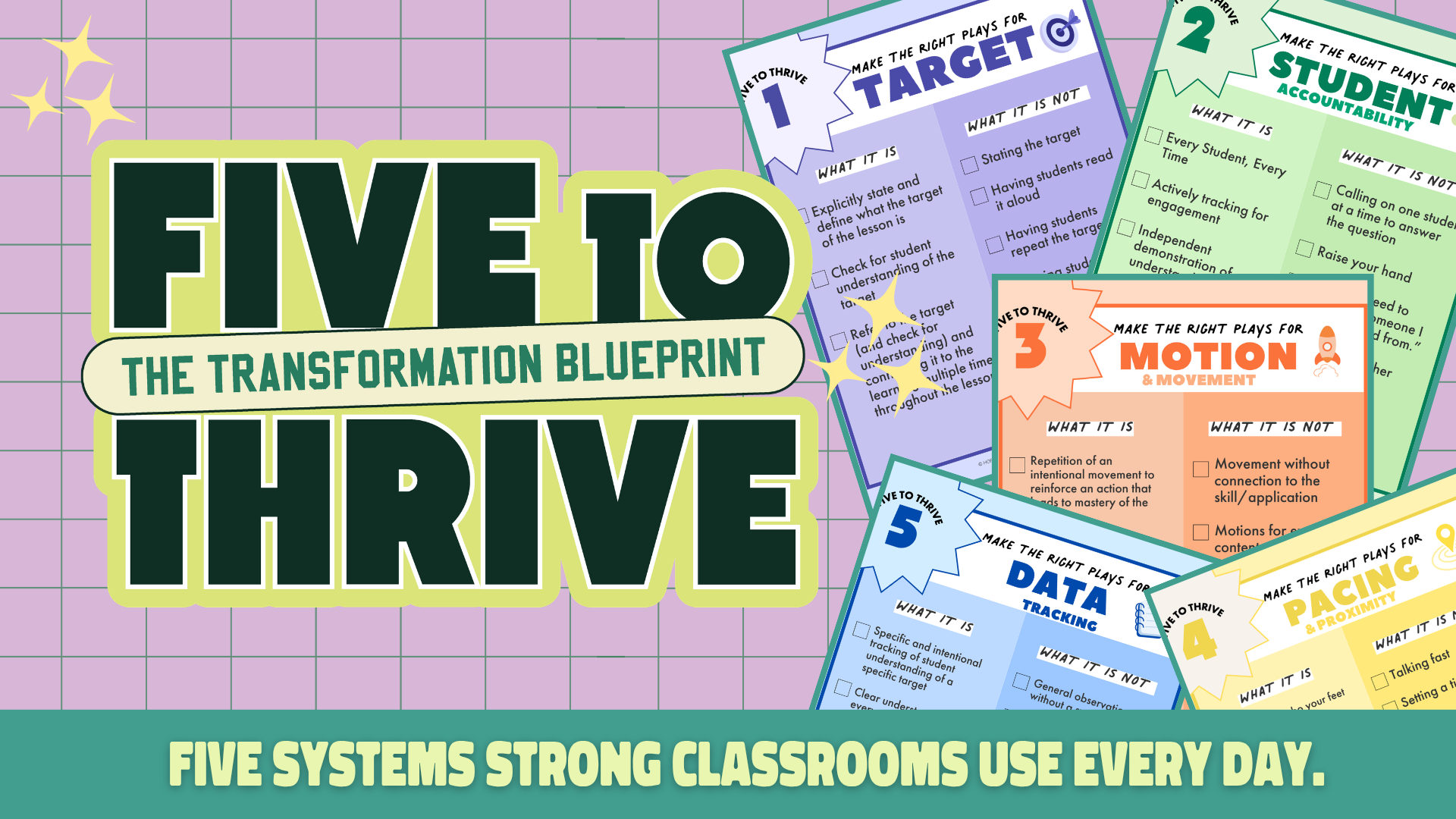
Across hundreds of classrooms, the strongest results come from five consistent systems:
1. Clear Learning Targets
Students know what they are learning and what success looks like
Not just posted
But understood
2. Student Accountability
Every student is thinking and responding
Not just a few
Every student. Every time.
3. Motion & Movement
Movement tied directly to learning
Not random
But purposeful
4. Proximity & Pacing
Intentional movement and strong momentum
Not just walking or counting down
But strategic presence and outcomes
5. Data-Informed Instruction
Real-time checks that guide next steps
Not just collecting
But responding immediately
Where most classrooms get stuck
You’ve heard these before.
You may even be doing them.
But when they aren’t clearly defined…
They get implemented loosely.
And loose implementation leads to weak results.
What It Is vs. What It Is Not
This is the shift.
Because without clarity, everything lives in the gray.
A target posted ≠ students understand it
Participation ≠ accountability
Movement ≠ mastery
Walking ≠ proximity
Exit tickets ≠ data use
And when we don’t define this…
We waste time on things that look right… but don’t work
Why this matters right now
Because time is limited.
Energy is limited.
You cannot afford to spend time on practices that don’t produce results.
This isn’t about doing more.
It’s about doing the right things… the right way.
So where do you start?
Not with everything.
With clarity.
What matters most
What it looks like
What to focus on first
Because when Tier I is strong:
Behavior improves
Gaps close
Students feel success
Motivation builds
This is why we built the Five to Thrive Implementation Blueprint
Because knowing the five systems isn’t the problem.
Implementing them consistently is.
This is a yearlong approach that:
Breaks each system down step by step
Defines what it is and what it is not
Focuses on one priority at a time
Builds habits that stick
This isn’t about teaching your curriculum with fidelity to a script.
It’s about teaching your curriculum with fidelity to results.
You can check out our year-long plan that will walk you through transformative teaching practices step by step HERE!
Or, you can check out our FREE Five to Thrive Resource to get started.
Before you go…
If everything feels harder right now…
It’s not because you’re doing something wrong.
It’s because what once worked…
isn’t working the same way anymore.
And that’s not failure.
That’s a signal.
A signal that it’s time to shift.
Not away from Tier I.
But back to it…
the right way.
You’ve got this, teachers!
Hope
