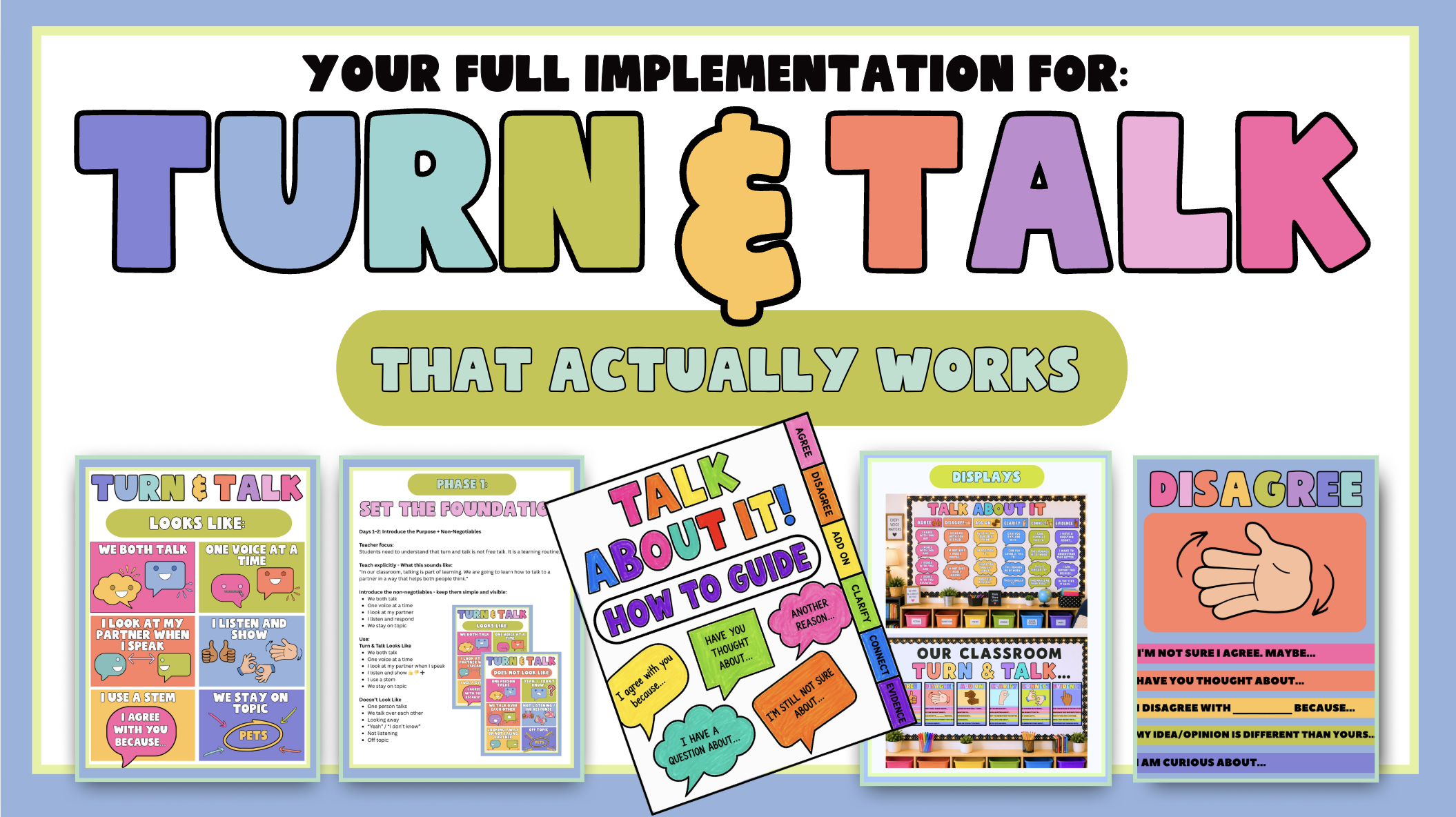
Turn and talk SHOULD be one of the most powerful strategies in your classroom.
Turn and talk SHOULD be one of the most powerful strategies in your classroom.
But if we’re being honest…
just because it’s happening
doesn’t mean it’s working.
And that’s not just true for turn and talk.
Before We Even Start: The Standard for Any Strategy
Even the best instructional strategies…
can waste your instructional minutes
if they’re not actually moving learning forward.
So here’s the real question:
How are you evaluating the strategies you use?
Are you looking at the results they’re producing?
Or are you just going through the motions…
without actually tracking how they’re moving learning forward?
Because if a strategy isn’t getting results,
it’s not neutral.
It’s costing you time.
So let’s dig into one of the most common strategies we see…
Turn and talk.
What It Looks Like in Real Classrooms (And Why We Misread It)
You say “turn and talk”…
and you get:
One student doing all the talking
One student nodding just to move on
Both students staring, waiting for someone to go first
“I don’t know” on repeat
Or somehow… they’re talking about lunch
So naturally we think:
“They don’t understand it.”
Or we keep going through the motions of the strategy…
without it actually moving learning.
But a lot of times?
That’s not actually the problem.
The Real Issue: We Skipped the Instruction
We treat it like:
“It’s just turn and talk.”
But what we’re actually asking students to do is this:
Listen to someone else’s thinking
Process what they heard
Compare it to their own thinking
Respond clearly and appropriately
That’s a complex cognitive and communication task.
And most of the time…
we never actually taught them how to do it.
So the strategy becomes a checkbox:
✔️ “I added engagement”
✔️ “Kids are talking”
…but the learning?
Isn’t actually moving.
The Shift: It’s Not About Talking—It’s About Thinking
Turn and talk is not about getting students to talk.
It’s about getting students to:
Process their thinking
Engage with someone else’s thinking
Respond with purpose
Out loud.
And if we want that to happen…
we have to set it up with intention.
The 5-Part System to Make Turn and Talk Actually Work
1. Clear Prompts and Purpose (Targets Drive the Talk)
If the prompt isn’t clear, the conversation won’t be either.
What most prompts sound like:
“Turn and talk about what we just learned.”
This creates:
No clear thinking task
No direction
No way to measure success
What strong prompts sound like:
“Turn and share your inference. Use BOTH evidence and background knowledge.”
Now we have:
A clear target
A clear thinking task
A clear success criteria
Implementation Tip
Before every turn and talk, ask yourself:
What exactly do I want students to think about and say?
If you can’t answer that in one sentence…
your students won’t be able to either.
2. Explicit Modeling (Teach the Skill of Conversation)
We cannot assume students know how to have an academic conversation.
We have to teach it like any other skill.
Step 1: Teach Conversation Stems (Give Them a Way In)
Most students don’t struggle because they don’t know.
They struggle because they don’t know how to say what they know.
Give them language:
“I agree with you because…”
“I disagree because…”
“I want to add on…”
“My evidence is…”
This removes the barrier of:
“I don’t know how to start.”
Step 2: Teach “Agree/Disagree” as Thinking, Not Compliance
When students agree or disagree, they must:
Evaluate what they heard
Compare it to their thinking
Justify their response
That’s higher-level thinking.
Step 3: Teach Them How to Listen (This Is the Game Changer)
Listening is not silence.
Listening is active processing.
Use hand signals to allow students to consistently demonstrate listening, thinking, and processing.
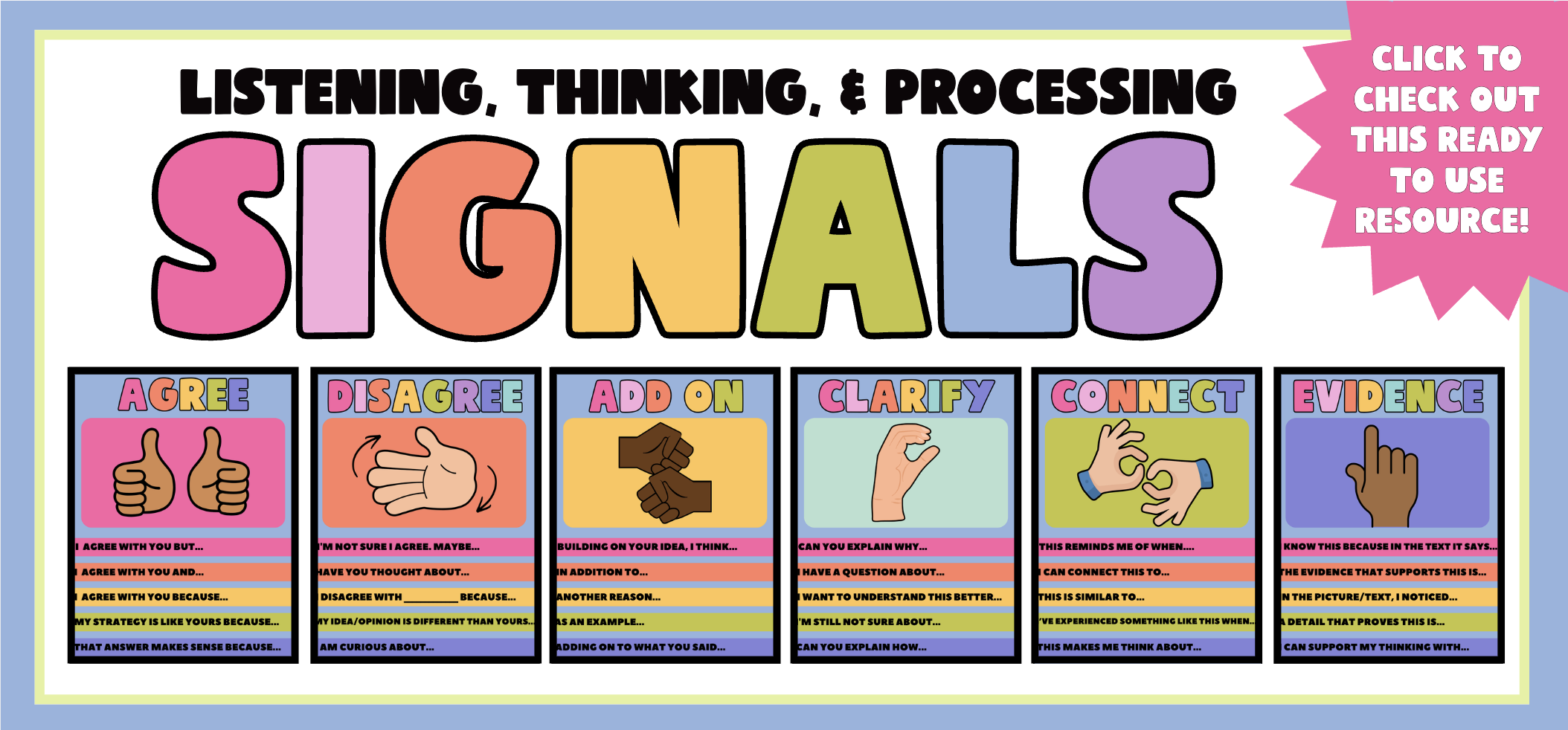
Why this works:
Forces real-time thinking
Keeps both students engaged
Reduces interruptions
Gives the “listener” a job
Now students aren’t waiting to talk…
they’re tracking thinking.
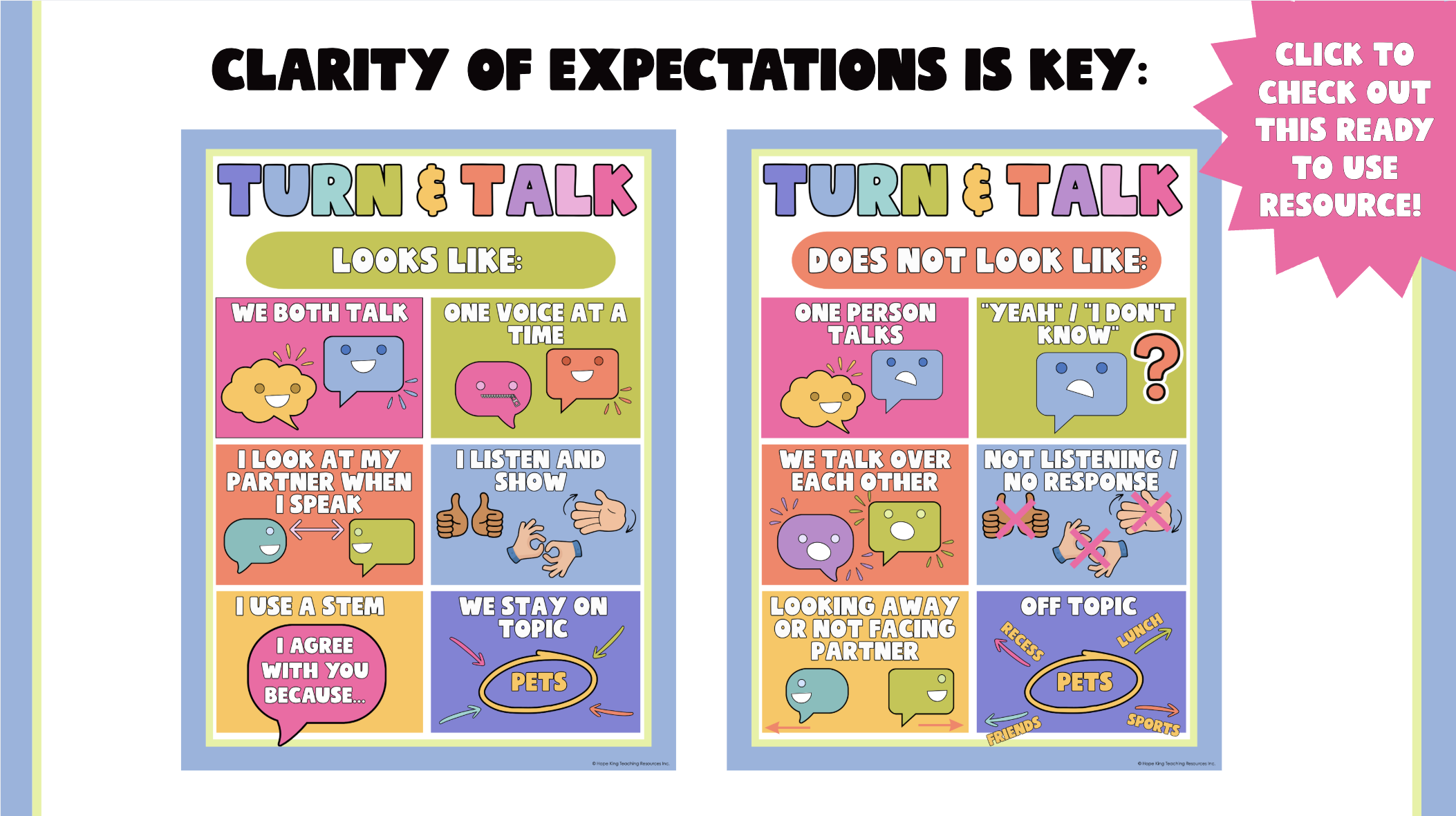
Step 4: Model Both Right and Wrong
Show them:
What it looks like
What it sounds like
What it does NOT look like
Then practice it together. Clarity in our expectations will in every single time!
3. Time It Intentionally (Pacing Drives Quality)
More time does NOT equal better conversations.
More time usually leads to:
Off-task behavior
Awkward silence
Lost momentum
What works:
30–60 seconds per student (depending on grade level and topic)
Clear start and stop
Structured sharing
Implementation Tip
Say:
“You have 30 seconds each. Partner A goes first.”
Then switch.
Keep it tight. Keep it focused.
4. Every Student, Every Time (Accountability Systems Matter)
If it’s not every student…
it’s not working.
Without structure, you will always get:
One student carrying the work
One student opting out
Step 1: Write Before You Talk
Give students time to think first.
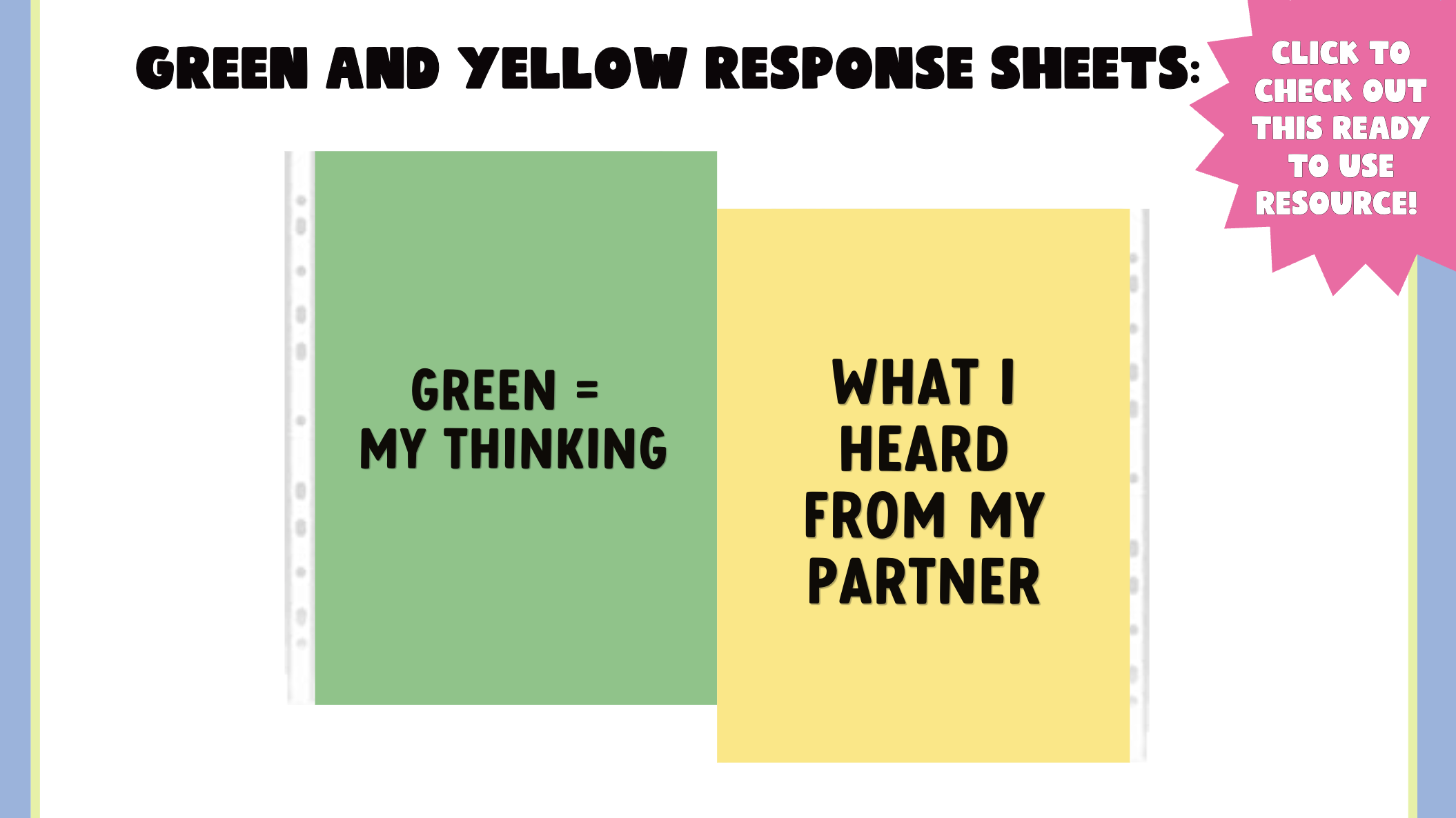
Use a simple system:
Green = my thinking
Yellow = what I heard from my partner
Now:
Every student has something to say
Every student has something to listen for
Every student has something to respond to
Step 2: Equal Air Time
Structure it:
Partner A talks
Partner B responds
No skipping. No opting out.
5. Teacher Tracking (This Is Where It Becomes Instruction)
While students are talking…
you are not just circulating.
You are collecting data.
What to listen for:
Who’s getting it
Who’s stuck
Who can explain clearly
Who is surface-level
This is real-time data.
Not after the lesson.
Not at the end.
Right now.
What you do with it:
Stop and clarify
Reteach immediately
Pull a small group
Adjust pacing
This is where turn and talk becomes instruction—not just engagement.
The Bottom Line
Turn and talk isn’t the problem.
Lack of clarity is.
When it’s done right, it becomes:
A thinking routine
An accountability system
A real-time data tool
And most importantly—
a way to ensure every student is engaged in learning.
Want Help Setting This Up in Your Classroom?
I created a full implementation plan with 10 simple phases. Each phase gives you the step-by-step implementation to establish effective turn and talk in your classroom plus all of the resources you need to:
Teach conversation stems
Set clear expectations
Build student accountability
You can check out the full resource HERE!