
Why Is First Grade So Hard?
The Three Hidden Struggles That Keep Teachers Up at Night
First grade is the year where everything starts to click or everything starts to collide.
You have moved beyond kindergarten routines and expectations.
You are facing reading and math demands head on.
Students are expected to read independently, write clearly, and think with purpose while still developing socially and behaviorally.
On paper it looks like first grade.
In reality, it feels like 17 different grades at once.
And as the year progresses, the pressure increases.
Here is the honest truth.
Your first grade students are not just young learners. They are wildly different learners.
And most classroom systems were not built for that level of complexity.
The Three Real Problems First Grade Teachers Shared
Before we built this year’s First Grade track, we asked teachers a simple question.
What is keeping you up at night?
Their answers were consistent.
Behavior Management That Disrupts Learning
First grade is the age where independence is expected but impulse control is still developing.
Teachers are navigating boundary pushing, emotional regulation, and attention challenges in the middle of academic demands.
More than charts or consequences, teachers want systems that prevent disruption and protect learning time.
Small Groups That Feel Chaotic Instead of Intentional
First grade teachers know small groups matter.
But many told us:
I do not know exactly what to teach at my table.
The rest of the class melts down while I am meeting.
My small groups do not feel purposeful.
Small groups should be where acceleration happens.
Instead, they often feel overwhelming.
Solid Tier I Instruction That Actually Works
First grade is foundational.
Strong Tier I instruction determines whether students build momentum or begin to fall behind.
But many teachers feel unclear about:
What to prioritize first
How to check for mastery
What strong instruction actually looks like in real time
Without clarity, instruction starts to feel like guesswork.
And guesswork is exhausting.
What No One Talks About
When behavior, unclear small groups, and inconsistent Tier I collide, something quiet happens.
Students plateau.
Not because they are incapable.
Not because teachers are not trying.
But because foundational instruction is not always explicit, systematic, and predictable enough to stick.
And when that happens, teachers work harder instead of smarter.
A Real First Grade Example
Picture a small group working on long vowel silent e words like:
make
take
hope
bite
Behind those four words are multiple cognitive demands:
Identifying vowel sounds
Recognizing silent e patterns
Holding sounds in working memory
Blending accurately
Reading fluently
Now add classroom behavior, attention regulation, and the rest of the class working independently.
That is cognitive load for students.
And for teachers.
If decoding is not automatic, comprehension becomes fragile.
If routines are not predictable, behavior increases.
If small groups lack structure, progress slows.
This is why first grade can feel overwhelming.
What First Grade Instruction Must Do
To truly move students forward, instruction must be:
Explicit and systematic
Predictable and structured
Purposeful in small groups
Aligned between behavior systems and academic routines
Focused on reducing cognitive load
This is not about doing more.
It is about strengthening the foundation.
Built From What Teachers Told Us
That is why we built this year’s First Grade track around the struggles teachers shared.
Clear behavior systems that protect learning
Purposeful small group structures
Tier I instruction grounded in research and evidence
Practical tools that work in real classrooms
And you will not just hear about strategies.
You will see them in action.
Real classrooms.
Real students.
Real instructional moves.
The Question Worth Asking
If first grade feels harder every year, is it because students are less capable?
Or is it because instruction has not been simplified and strengthened enough to match today’s classroom reality?
What happens when behavior systems, small groups, and Tier I instruction finally work together?
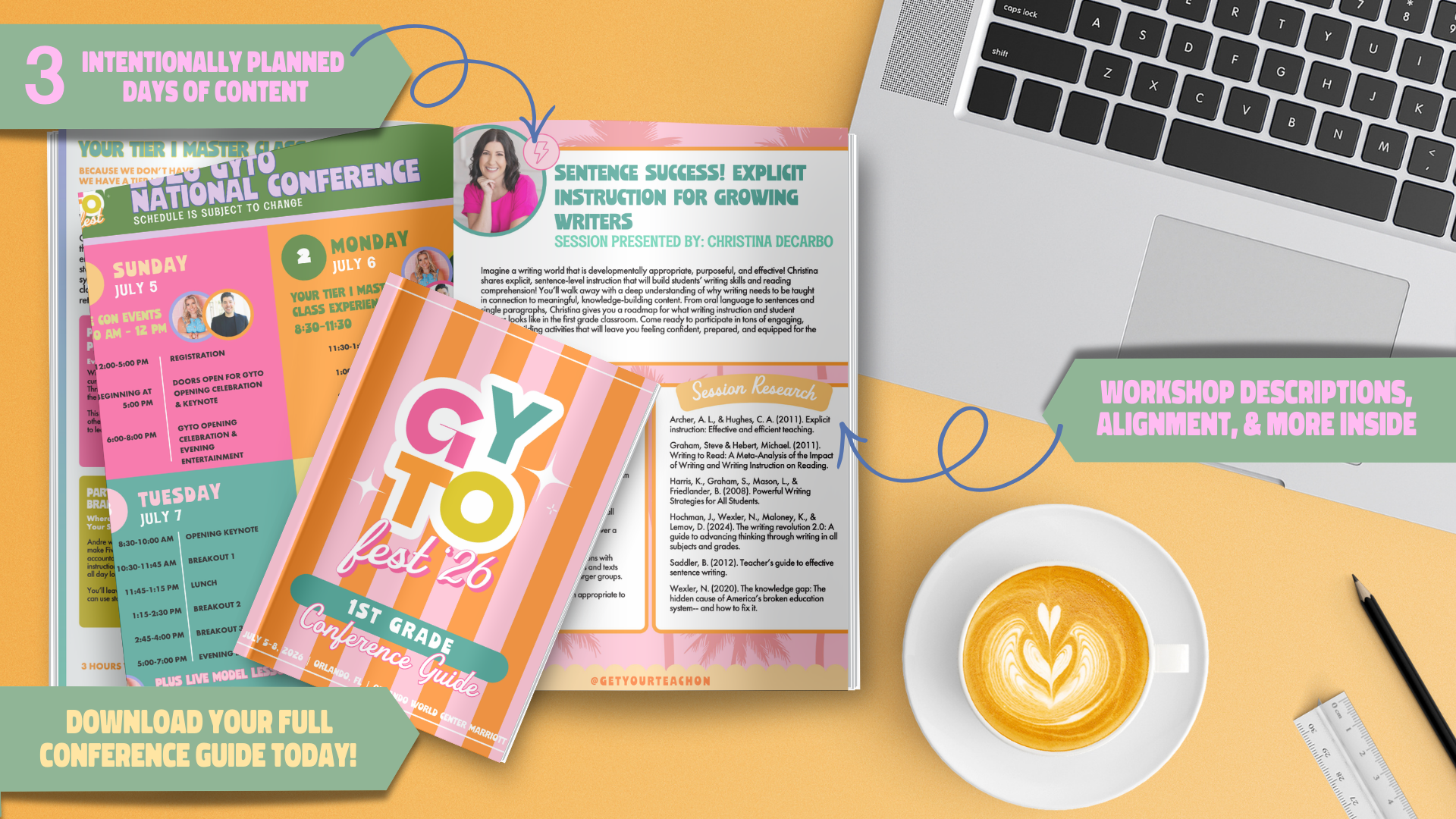
Explore the full First Grade Conference Guide to see every workshop, every session focus, and how this experience is designed to make first grade feel clear instead of chaotic.
First grade does not have to feel impossible.
It just has to be intentional.
