
If there is one thing I know for sure, it is this:
Strong classrooms are built on strong systems.
Not more curriculum.
Not more programs.
Not more noise.
Systems.
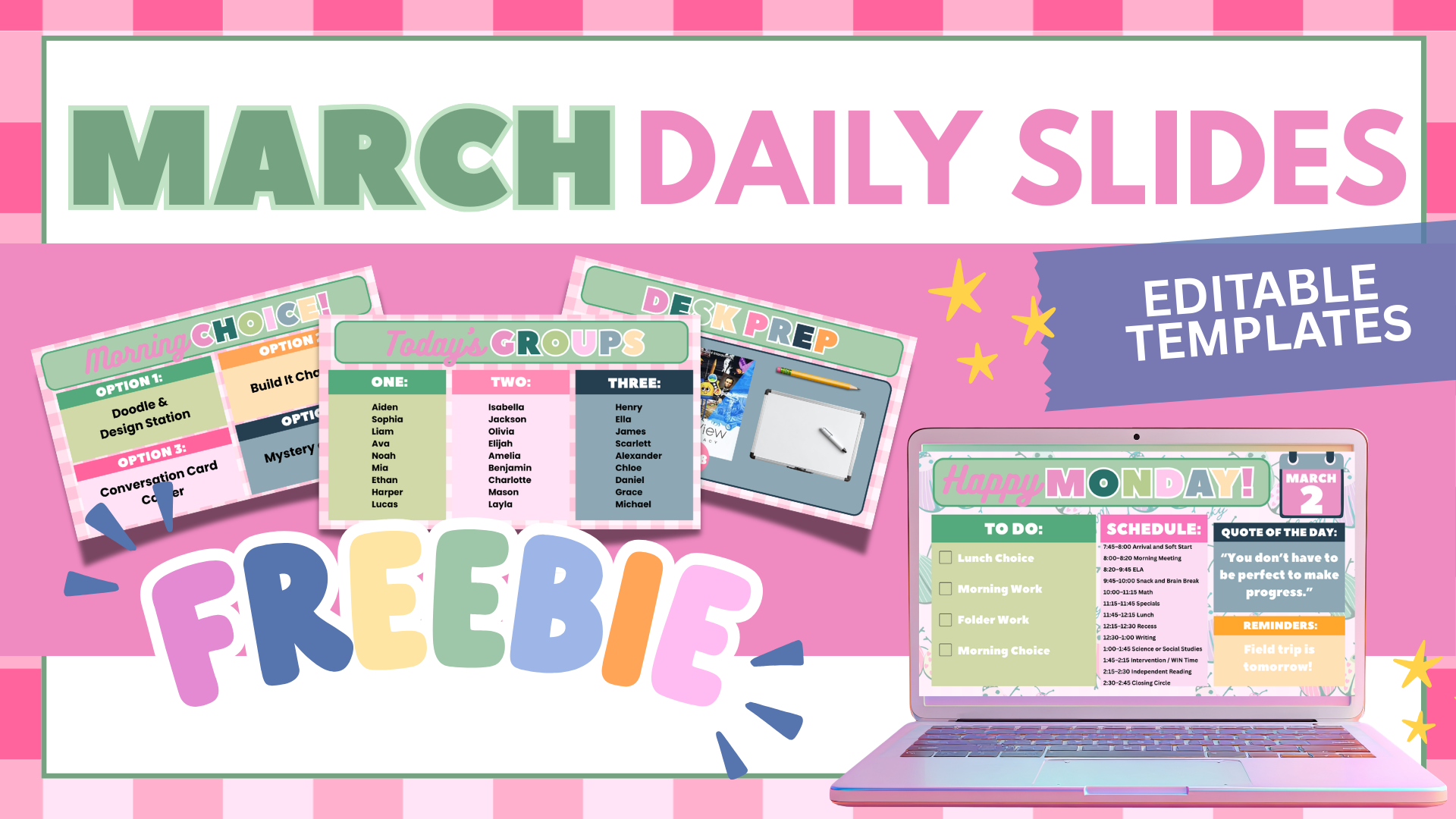
These Daily Slides were not created to be “cute.” They were created to help you build predictable routines that increase instructional time, decrease behavior issues, and make your day feel smoother from start to finish.
Here is exactly how to use each one intentionally in your classroom.
1. Morning Slides: Set the Tone in 5–7 Minutes
I believe deeply in morning meeting. And I do not mean calendar time.
I mean a focused 5–7 minutes to connect, align, and motivate.
Each week, your Morning Slides include a fun focus:
Quote of the Day
Fun Fact of the Day
Joke of the Day
Challenge of the Day
Use this time to build community and energy. Laugh at the joke. Think about the quote. Tackle the challenge together.
Then shift.
Go over your goals for the day.
Clarify what success looks like.
Get students mentally ready.
I want you to think of yourself as the coach. If every day is the Super Bowl, how are you motivating your team before kickoff?
This small investment of time changes everything.
2. Morning Choice Slides (Soft Starts): Regulate Before You Educate
How you start your day is how you end your day.
And we are not starting our mornings with kids on computers. Full stop.
Even traditional “morning work” like journaling or math warm ups can feel like an academic trigger the second students walk in. For some students, that immediate demand can escalate behaviors before the day even gets going.
Instead, use a Soft Start.
For the first 10 minutes, students choose one of four engaging activities. These are low pressure, collaborative, and fun. They allow students to talk, create, build, and ease into learning.
Choice builds ownership.
Connection builds regulation.
Fun builds buy in.
You are not lowering expectations. You are creating readiness.
3. Desk Prep Slides: Eliminate Wasted Transition Time
One of the most transformational systems in my classroom was getting students from instruction to independence quickly.
That only happens when materials are ready before instruction begins.
When you transition subjects, project a Desk Prep Slide that lists every material students will need for the lesson.
Then press play on a 60 second song.
By the time the music stops, desks must be set and ready.
No “What do I need?”
No slow starts.
No wandering.
When instruction ends, students can immediately begin independent work.
This system alone can give you back minutes every single day. And minutes add up.
4. Sticky Session Slides: Use Hot Data in Real Time
If we are going to talk about strong instruction, we have to talk about responsive instruction.
Sticky Sessions are my system for collecting hot data at the close of a lesson.
As students complete independent work, quietly hand them one of three colored sticky notes. They do not know what the colors mean. You do.
One represents above level understanding.
One on level.
One below level.
At the end of the lesson, project the differentiated question slide. Each student answers the question that corresponds to their sticky note color as their exit ticket.
They turn in the sticky notes.
And just like that, you have immediate data.
No grading stacks.
No guessing.
No waiting days to respond.
The next day, use those sticky notes to:
Form fluid small groups
Target misconceptions
Pre teach for your bubble group
Simple system. Powerful impact.
5. Grouping Slides: Make Small Group Time Strategic
Small group time should feel purposeful, not chaotic.
Instead of calling out names or rearranging groups on the fly, project your Grouping Slide. Students move quickly and quietly to their assigned group.
You can group by:
Skill need
Strategy focus
Data from Sticky Sessions
Behavior goals
Collaborative task
Because the grouping is visual and predictable, transitions are smoother and instructional time is protected.
Fluid groups.
Clear expectations.
Intentional movement.
Why These Slides Matter
These Daily Slides are not about decoration.
They are about daily instructional systems.
When students:
Know how the day begins
Understand expectations for transitions
Have materials ready
Receive instruction aligned to their level
Move through small groups smoothly
Behavior decreases.
Engagement increases.
Learning accelerates.
And the best part? You are not adding something new. You are tightening what already exists.
Strong classrooms are not built by chance.
They are built by design.
And sometimes the smallest systems create the biggest shifts.
You can download this resource for free in the GYTO Library HERE!
