
Intervention Can’t Fix What Tier I Instruction Should Prevent.
There’s a question schools need to start asking more honestly.
If best instructional practices are proven to grow students…
why aren’t we using them consistently?
Across the country we are seeing more students identified for:
• intervention
• RTI support
• pull-out services
• specialized tiers
But very few people are willing to ask the uncomfortable question sitting underneath all of it:
What if the issue isn’t intervention…
what if the issue is Tier I instruction?
Because the truth is simple.
You cannot intervene your way out of a Tier I problem.
The Research Is Clear: Instruction Matters More Than Location
Education researcher John Hattie analyzed over 800 meta-analyses representing more than 80 million students.
One of the most powerful conclusions from his work was this:
The quality of teaching has a greater impact on student learning than the school they attend.
Not the zip code.
Not the building.
Not the demographics.
Instruction.
In other words, two students in the same building can experience completely different outcomes depending on the quality of instruction happening inside their classroom.
That’s powerful.
And it also means something important for how we think about supporting students.
If Tier I instruction is inconsistent…
intervention systems will always be overwhelmed.
The Question I Get After Almost Every Model Lesson
After teaching a model lesson, especially when it’s in a specific grade level, I hear the same question over and over again.
Someone will raise their hand and ask:
"This was great… but what does this look like in kindergarten?"
Or someone else will say:
"Okay but what would this look like in 5th grade?"
And my answer is always the same.
Exactly the same.
The content changes.
The curriculum changes.
But how you teach it does not.
Tier I instruction isn’t grade-level specific.
It’s student-learning specific.
The systems that drive learning in kindergarten are the exact same systems that drive learning in fifth grade.
The Question I Got on Instagram Recently
Recently someone asked me a different version of this question on Instagram.
They said:
"I’m not worried about the grade level… but what does this look like in inner-city schools with 25+ students and high inclusion?"
My answer?
Exactly the same.
I’ve taught in inner-city schools.
My largest class size was 40 students.
For six years of my career my average class size ranged between 30 and 40 students.
And over the last several years, many of the campuses we work with operate at 100% full inclusion, some serving 30+ languages, with extremely high EL populations.
Many of those schools serve communities where 100% of students qualify for free and reduced lunch.
And the instructional practices that move student learning forward?
They look exactly the same.
Not easier.
Not watered down.
Not completely different.
The systems stay the same.
Because strong instruction is not dependent on class size, zip code, or demographics.
It’s dependent on consistency.
The Moment That Made This Click
Years ago we were working with a school in California.
After teaching a model lesson, a teacher came up and asked a question that stuck with me.
She said,
"This was amazing… but what curriculum is this?"
And I remember pausing for a moment because the answer was simple.
It wasn’t curriculum.
Nothing about the lesson had anything to do with a specific program.
What she had just watched was how to teach, not what to teach.
And that’s where so much confusion exists in education.
Curriculum is what you teach.
Tier I instruction is how you deliver it.
When those two things get blended together, we start believing that better curriculum will fix instructional problems.
But curriculum cannot fix instruction.
Only instructional systems can do that.
Being Well-Read Is Not the Same as Being Well-Practiced
Teachers today know more about research than ever before.
Ask educators about:
• learning targets
• student engagement
• accountability systems
• formative assessment
…and most teachers can tell you exactly what those things are.
But knowing about best practices and consistently implementing them are two very different things.
One of the most common things we see in classrooms is this:
Teachers believe they are doing these practices…
but when you observe instruction, those practices appear only occasionally.
Or they happened earlier in the lesson.
Or they were visible for one moment, but not sustained throughout the learning.
The instructional practices that grow students are not one-time events.
They are instructional systems that happen:
Every lesson.
Every student.
Every time.
The Five Systems That Change Everything
After observing classrooms across the country, we began noticing something consistent.
The most effective classrooms all had the same five instructional systems in place.
Not programs.
Not trends.
Not activities.
Systems.
Systems that ensured:
• students knew exactly what they were learning
• every student was responsible for thinking
• instruction kept students actively engaged
• teachers maintained strong instructional presence
• learning progress was visible
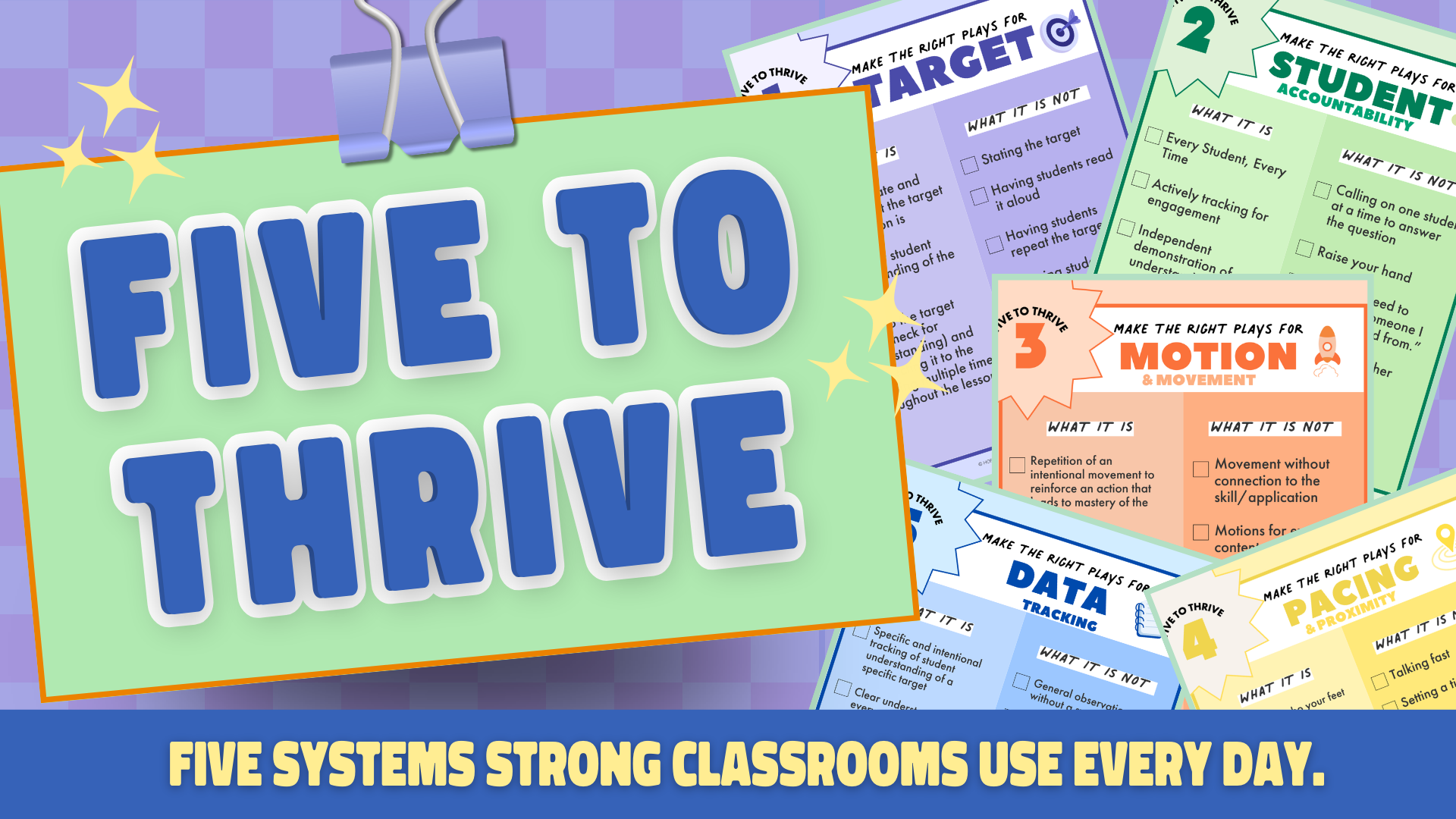
These systems became what we now call: The Five to Thrive
Five instructional drivers that ensure Tier I instruction is doing the heavy lifting.
The Five to Thrive Profiles
Targets
Students should always know:
• what they are learning
• why it matters
• what success looks like
Clear learning targets give instruction direction and purpose.
Without them, students complete activities but don’t always understand the learning.
Accountability
In strong classrooms, every student is responsible for thinking.
Not just the students who raise their hands.
Instructional accountability systems ensure teachers can quickly see who understands and who needs support.
No disappearing.
No passive participation.
Everyone thinks.
Motion & Movement
Movement in the classroom isn’t about chaos.
It’s about intentional instructional energy.
Strategic movement increases oxygen to the brain, improves focus, and helps anchor learning.
When movement is connected to thinking, engagement naturally increases.
Proximity & Pacing
Great teachers rarely stay in one place.
They move with purpose.
They scan the room.
They adjust pacing based on what students need in the moment.
That instructional presence allows teachers to respond before confusion or disengagement grows.
Data Tracking
The strongest classrooms make learning visible.
Students know:
• where they are
• where they are going
• how they are progressing
When students can see their growth, motivation increases and instruction becomes more responsive.
When Tier I Is Strong, Everything Changes
When these five systems are consistently in place:
Students are more engaged.
Teachers gain clearer instructional insight.
Learning accelerates.
And something else happens.
The need for intervention decreases.
Because intervention should never be the system doing the heavy lifting.
Tier I instruction should.
Want to See What These Systems Actually Look Like?
One of the biggest challenges with instructional practices is that many educators believe they are already doing them.
Until they see what consistent implementation actually looks like.
That’s exactly why we created the Five to Thrive Profiles.
Inside this free guide you'll see:
• what each practice is
• what each practice is not
• what these systems actually look like inside real classrooms
Because the difference between knowing about best practices and seeing them clearly can change everything.
Download the Free Five to Thrive Profiles
If you want to strengthen Tier I instruction in your classroom or school, this guide is the perfect place to start.
Download the Five to Thrive Profiles here:
or check out our full implementation model for classrooms and schools!
Because when Tier I instruction is strong…
intervention becomes support.
Not survival.
