
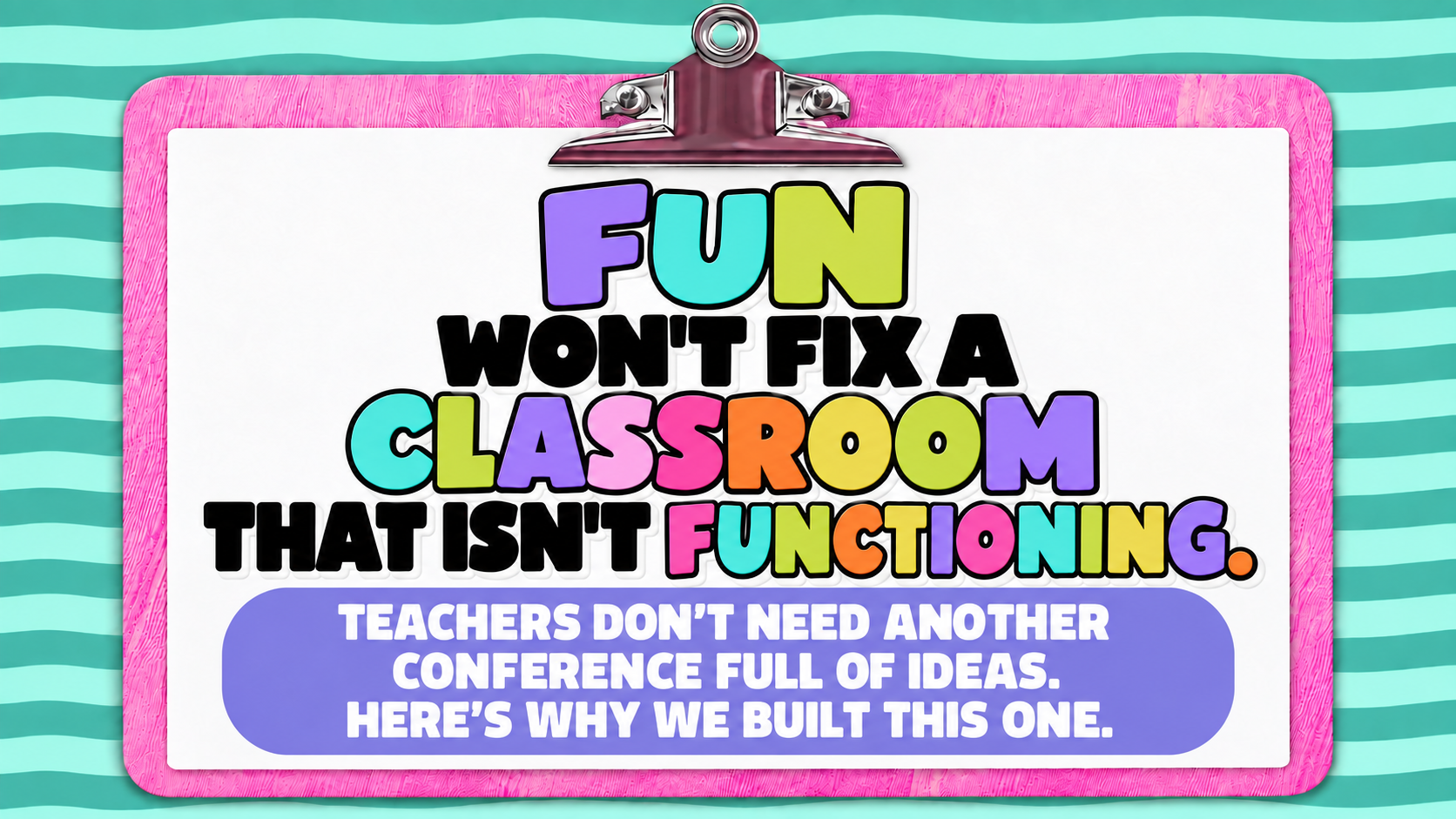
Teachers Don't Need Another Conference Full of Ideas. Here's Why We Built This One.
Teachers have access to more resources, curriculum, strategies, activities, and ideas than ever before. The problem isn't access to more stuff. The problem is turning all of those things into instruction that actually works with 25+ students sitting in front of you.
That's why we built the GYTO Pop-Up Conference.
We wanted to create a professional learning experience centered on the part of teaching that often gets overlooked: delivery.
How do you take the curriculum sitting on your desk and actually bring it to life? How do you create classroom systems that allow you to teach instead of spending half the lesson managing? How do you get every student participating instead of relying on the same five hands? How do you know, while you're teaching, whether students are actually learning? And when they're not, what do you do next?
We also wanted to answer a question that I think matters just as much: How do you make learning engaging, memorable, and FUN without sacrificing strong instruction?
For us, it comes down to an order:
FUNCTION → INSTRUCTION → FUN
That's not just a catchy phrase. It's the foundation of what we want teachers to experience with us.
Function Has to Come First
Before we can make instruction better, we have to create a classroom where great instruction is actually possible.
Think about how much instructional time gets lost every day to things that have very little to do with the curriculum: passing out materials, getting students into groups, redirecting side conversations, repeating directions, waiting for everyone to get ready, managing partner conversations, or trying to regain attention after movement.
Thirty seconds here. Two minutes there. Five minutes somewhere else. It adds up.
But lost time isn't even the biggest problem. Weak classroom systems actually limit what a teacher is able to do instructionally.
You can't easily pull a small group if the rest of the room cannot function independently. You can't have meaningful partner conversations if students haven't been taught how to speak, listen, and respond. You can't incorporate movement if every transition becomes chaos. And it's incredibly difficult to collect real time data when you're spending the entire lesson managing behavior.
Function creates capacity for instruction.
That's why we spend time helping teachers think about the systems underneath the lesson. We don't just ask, What are students doing? We ask, How will this actually work with real students in a real classroom?
One of the simplest ways to identify a function problem is to pay attention to what you're constantly correcting. If you're saying the same thing over and over again, there's a good chance it needs to become something you explicitly teach.
We often assume students know how to do something because we've told them what to do. But telling students a routine and teaching students a routine are two very different things.
Teach it. Model it. Practice it. Give feedback. Reset it. Practice it again.
We need classroom routines strong enough to carry the instruction we want to put on top of them.
Then We Strengthen the Instruction
Once the classroom can function, we can focus on the heart of the work. Instead of constantly reacting instead of teaching we get to focus on: What are students actually learning?
This is where we want teachers to become incredibly clear about the instructional decisions they're making throughout a lesson. What is the learning target? How do both the students and the teacher own the outcome? What does mastery actually look like? Does every student know where the lesson is headed? Are all students expected to think and respond, or are we relying on the same handful of volunteers?
And then there is the question we don't ask nearly enough: How do you know?
How do you know who understands? How do you know who almost has it? How do you know who is completely lost? And can you figure that out while there is still enough time left in the lesson to do something about it?
Because collecting data after instruction is useful. Collecting data during instruction is powerful.
When teachers can read what's happening in front of them, they can make a decision. Keep going. Extend the thinking. Give a quick model. Have a partner explain. Add a scaffold. Pull a group. Reteach. Change the task. Collect again.
Those are the moves that turn a lesson plan into actual teaching.
And they are also the moves that curriculum alone cannot make.
Curriculum Is Dead Without Delivery
Schools and districts invest enormous amounts of money in curriculum, and they should invest in high quality instructional materials. Strong curriculum matters. Standards alignment matters. Great resources matter.
But purchasing the resource is only the beginning.
A curriculum cannot look around the room and realize that half the students are confused. It cannot hear a misconception during a partner conversation and decide to stop and address it. It cannot adjust the pacing because students need another example. It cannot recognize that the task is too easy for one group and inaccessible for another.
The teacher does that.
The curriculum provides the WHAT. The teacher is responsible for so much of the HOW.
That's why I keep coming back to this:
Curriculum is dead without delivery.
If we want the money we're investing in curriculum to actually translate into better experiences and outcomes for students, we have to invest in the people responsible for delivering it.
And I would argue that investment should be equal to, if not greater than, what we're willing to spend on the resource itself.
Teachers don't just need another presentation ABOUT instruction. They need opportunities to see great instruction, experience it, practice it, study it, talk about it, and then take it back to their classrooms.
That's what we want professional learning to be.
And Then...We Make It Fun
Yes, fun.
Because we believe learning can be highly effective and ridiculously engaging at the same time.
And this is probably where we need to address something that has followed GYTO for years.
If you've seen one of our conferences on Instagram, you've probably seen the fun. You've seen music, movement, laughter, energy, teachers participating, and a room that doesn't look like traditional professional development.
And sometimes, that's exactly what makes it harder for a teacher to get funding to attend.
“It looks fun.”
It does.
That's intentional.
But I think we should be concerned when fun immediately becomes evidence that professional learning must somehow be less rigorous.
Not because everything that's fun is automatically effective. It's not. We would never say that about a classroom, and we shouldn't say it about adult learning either.
A room full of teachers laughing, moving, and participating doesn't prove that great professional learning is happening.
But a room full of teachers sitting silently and taking notes doesn't prove it either.
The question shouldn't be, “Did it look serious enough?”
The question should be, “What did they learn, and what will they be able to do differently because of it?”
Those are very different questions.
Teachers Should Experience the Learning We're Asking Them to Create
Think about what we ask teachers to provide for students.
We want student centered classrooms. We want active participation. We want collaboration. We want movement. We want students talking about their learning. We want lessons that are memorable. We want kids engaged in what they're doing.
Then teachers walk into professional learning where those exact principles are being modeled, and somehow we become suspicious because they're enjoying themselves.
Fun and rigor are not mutually exclusive. Neither are joy and effectiveness.
In fact, we want teachers to experience the kind of learning we're asking them to create.
If we're teaching intentional movement, you're going to move. If we're talking about student accountability, you're going to experience structures that create accountability. If we're teaching active listening, we're going to model what active listening actually looks and feels like. If we're talking about pacing, you're going to experience intentional pacing.
And if we're teaching teachers to collect real time information from students and respond to it, then our presenters better be reading the room and responding to the learners sitting in front of them too.
Professional learning shouldn't just tell teachers what strong instruction looks like.
It should model it.
That's why the fun you see at GYTO isn't something sitting on top of the learning. It's part of a much bigger instructional design.
We start with FUNCTION. We strengthen the INSTRUCTION. And then we use FUN to amplify both.
What Will You Actually Learn at a GYTO Pop-Up Conference?
Our Pop-Up Conferences aren't designed around giving teachers 100 more activities to add to a folder and hopefully remember someday. We want teachers to leave better at the work they already do every single day.
We dig into the classroom systems and routines that protect instructional time and make more complex instruction possible. We examine the connection between strong Tier I instruction, engagement, and behavior. We help teachers build student accountability so every learner is expected to think, talk, respond, and participate, not just the students who are quickest to raise their hands.
We also get incredibly practical. What does intentional movement actually look like? How do you use proximity and pacing to keep a lesson moving? How do you collect hot data while you're teaching? How do you use that information to make your next instructional move? How can small shifts in transitions, response structures, student talk, and lesson delivery completely change the experience students have?
And yes, we're going to have fun doing it.
Because we aren't asking teachers to choose between a classroom that works and a classroom kids love being in.
We want both.
Function. Instruction. Fun.
That's the progression behind so much of what we teach.
Function creates the conditions for learning. Instruction moves students toward mastery. Fun amplifies the experience.
Take away function and the fun can become chaos. Take away strong instruction and the fun can become entertainment. Take away fun entirely and we may miss an enormous opportunity to create connection, curiosity, energy, and joy around learning.
But put all three together, and now we have something powerful.
That's exactly what we want teachers to experience at a GYTO Pop-Up Conference. Not another binder. Not another list of 47 strategies. Not another day of sitting and getting.
We want teachers studying the actual craft of teaching and experiencing what becomes possible when great delivery brings great curriculum to life.
We Know Funding Is Real
We also know many of the teachers reading this aren't the people who get to make the final decision about attending.
You may need approval. You may need professional learning funds. Your school may need to pay for a substitute. Your administrator may have seen a video from one of our conferences and wondered how the experience connects to the instructional priorities you're working on as a school.
We want to make that part easier too.
We've put together a complete breakdown of the GYTO Pop-Up Conference that you can share with your administrator, including what you'll learn, what you'll be able to take back and implement, how the learning connects directly to classroom instruction, and the details for each upcoming Pop-Up location.
We've also created a ready to use letter for your administrator that helps explain why attending isn't simply an investment in one day of professional development. It's an investment in the person responsible for bringing your school's curriculum to life every single day.
Because if we're willing to invest heavily in WHAT teachers are expected to teach, we have to be willing to invest in the people responsible for HOW students experience it.
Curriculum matters.
Resources matter.
But ultimately:
Curriculum is dead without delivery.
And great delivery doesn't happen by accident.
[EXPLORE THE GYTO POP-UP CONFERENCE + GET YOUR ADMIN LETTER]
